AI summary
Planning a milestone birthday dinner in Singapore starts with three decisions: the right space, the right group menu and a clear understanding of the final bill. This guide explains private dining formats, minimum spend, set menus, dietary planning, booking lead times and how service charge and GST affect per-head pricing.
If you have booked dinner for four many times, a table for thirty can still feel unfamiliar. The restaurant needs more than a date and a headcount because the evening has more moving parts.
Three decisions shape the booking. First, decide whether the group needs a space of its own. Next, choose a food format that lets the room eat at the same pace. Then work out how the quoted figure becomes the final bill.
That order matters. Speeches can change the room you need. The room can affect the minimum spend. The menu controls how quickly each course reaches a large table. Service charge and GST change the working budget.
A useful first enquiry therefore describes the evening before it asks for a menu. Once the restaurant knows the expected headcount, preferred date, programme and dietary needs, it can discuss a room and service format that fit the plan.
Headcount gives the restaurant a size. The programme tells it what the space needs to do.
A group that plans to stay at the table over dinner may work well within the main dining room. A group with speeches, a slideshow or guests moving between tables needs more control over sound, sightlines, movement and service timing.
Restaurants can usually offer three arrangements:
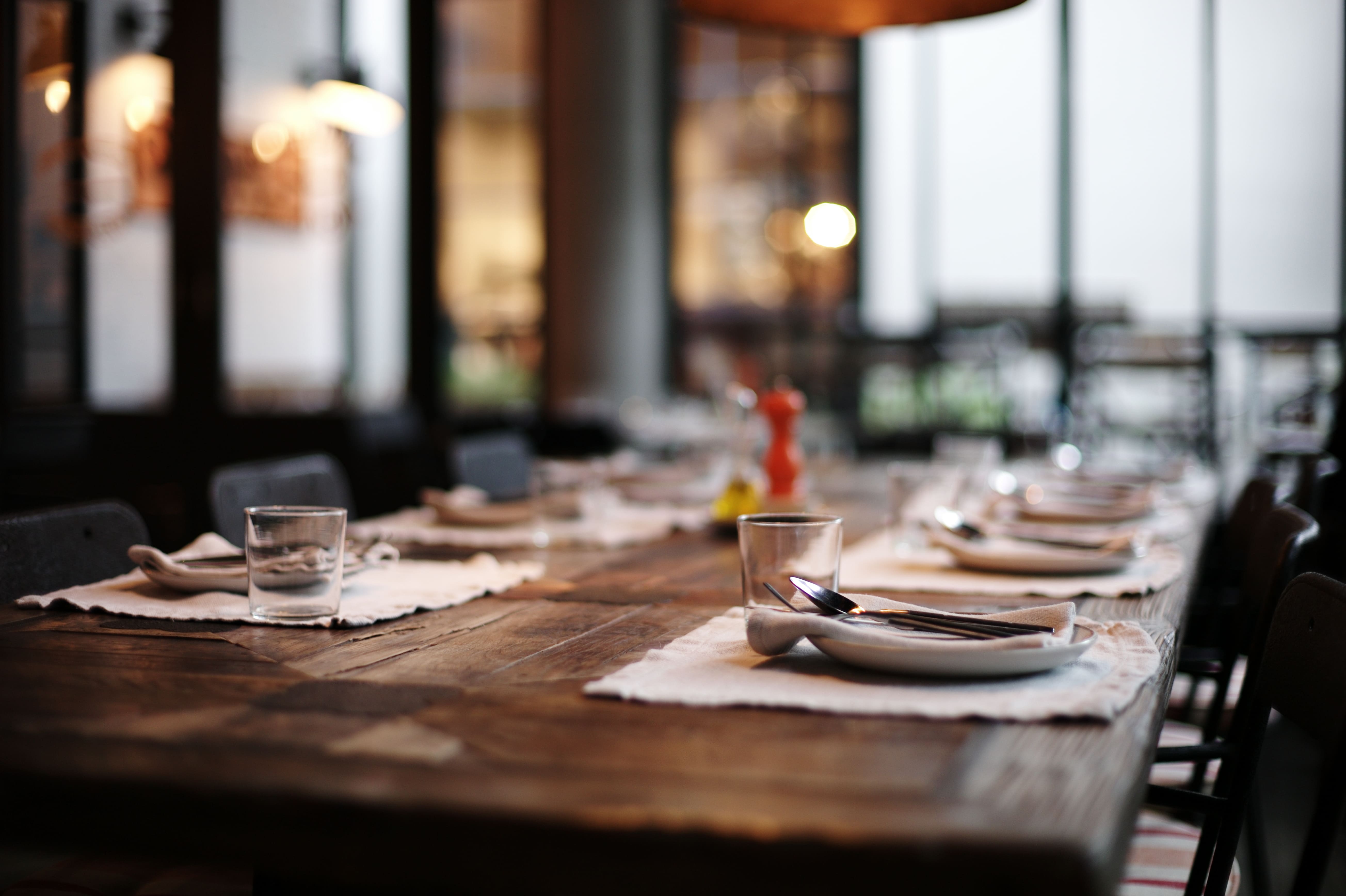
This is why two dinners with the same headcount can need different setups. Thirty guests having dinner together may need little more than a well-planned table arrangement. Thirty guests listening to a speech need everyone to hear the same person at the same time.
Capacity also changes with layout. One long table uses a room differently from several smaller tables. A screen, cake station, gift table or wider route for older guests takes up space that could otherwise hold chairs.
At Boat Quay, private-event arrangements include a separated dining area and exclusive use of the second level. Audiovisual (AV) facilities can also form part of the setup depending on the event format. If you are comparing a restaurant for a private event in Singapore, ask what part of the venue becomes exclusive and whether the setup supports the programme.
Once the room format is clear, the next question is the commitment attached to that space.
A minimum spend sets a food and beverage commitment for the booking. The group agrees to spend at least that amount on qualifying items during the agreed session.
A room hire fee is different. It charges for use of the space separately from the food and beverage bill.
For a restaurant booking, a minimum spend connects the private space to the meal taking place in it. The room is committed to one group during a service period, so the host can plan the menu and drinks against that agreed value.
The practical question is therefore what counts towards the minimum spend. Ask whether all food and beverage items qualify. Ask what charges sit outside it. Confirm the deposit, cancellation terms, booking duration and payment deadline at the same stage.
This makes the budget easier to build. A minimum spend is a booking condition, while the final bill still depends on what the group orders and which other charges apply.
Once those room terms are clear, the food format becomes the next part of the plan.
A large table creates a kitchen timing problem that a table for four rarely creates. Thirty separate à la carte orders can send guests through the meal at very different speeds.
A birthday dinner usually has shared moments. The room may pause for a toast. Someone may speak between courses. The cake may need to arrive at a particular point. Those moments work better when the table reaches each stage together.
A fixed multi-course menu gives every guest the same sequence. A limited-choice menu allows a small number of options within each course. Family-style service places shared dishes in the centre of the table.
Each format gives the kitchen a clearer service path. A fixed menu keeps the sequence tight. Limited choice adds flexibility without creating dozens of separate orders. Shared platters keep the group focused on the same food at the same time.
The shared format also suits the way many Italian family meals are served. Dishes move around the table and guests serve one another. Conversation stays centred on the meal.
Set menus also make dietary planning easier to organise. Dietary requirements can be worked into the menu before service. That is far more useful than trying to redesign dishes while thirty guests are already seated.
With the room and food format settled, the main budgeting question is how the quoted per-head figure becomes the final bill.

A per-head figure is only useful when you know what it includes. In Singapore, the order of service charge and GST matters because GST is calculated after service charge has been added.
Where a restaurant imposes service charge, quoted event-menu prices may be shown before service charge and GST. The Inland Revenue Authority of Singapore allows this price-display treatment for qualifying food and beverage businesses, provided a prominent statement tells customers that GST and service charge apply.
The arithmetic is straightforward once you use the correct sequence. Take $100 per person as an illustration. The $100 figure is a generic arithmetic illustration with no connection to Pasta Fresca pricing.
A 10% service charge adds $10 to the $100 food figure. That creates a subtotal of $110. GST at 9% is then calculated on $110, which adds $9.90. The final illustrated amount is $119.90 per person.
For thirty guests, the same illustration begins with $3,000 in food. Service charge adds $300, giving a subtotal of $3,300. GST at 9% on that subtotal is $297. The final illustrated total is $3,597.
The combined effect is 19.9% above the original food figure. Adding 10% and 9% as if both were calculated on the original price gives 19%, which misses the GST charged on the service charge.
This matters when you compare quotes. One quote may present its headline food figure differently from another. Put both on the same basis before you decide whether either fits the working budget.
Ask for the food figure before or after service charge and GST. Then ask which other items sit outside the per-head menu. Beverages, corkage, cake-cutting and audiovisual requirements can be separate booking items.
The point is to make the pricing basis clear. Singapore’s pricing framework allows specific display practices for service-charging food and beverage businesses, and the Competition and Consumer Commission of Singapore’s price-transparency guidance emphasises clear communication of unavoidable charges and pricing conditions.
A useful event quote should therefore give you enough information to calculate the full planned spend. Once that basis is clear, the remaining booking details become much easier to settle.
Five details can change the room, menu or final bill, so settle them before the booking is closed:
Dietary requirements deserve early attention. A kitchen can plan ingredient changes, substitutions, separate preparation and plating notes more reliably when the information arrives before service.
The headcount deadline matters for a different reason. Table layout, food quantities, staffing and place settings all follow the confirmed number. A late change can also affect the room commitment, so the policy should be clear before confirmation.
Speeches and cake belong in the service plan too. A toast can sit between courses. Cake can arrive after a chosen course. The kitchen then knows when the room needs a pause and when service should resume.
With those details agreed, the final planning question is when to secure the date.
Secure the date before spending too long choosing individual dishes.
For private events at Boat Quay, the current planning recommendation is to confirm at least 14 working days in advance. Larger groups and popular dates should be confirmed earlier. Friday and weekend evenings need earlier attention, and November and December also face demand from year-end company functions.
Use a simple sequence. Enquire and view the space first. Confirm the room next. Finalise the menu after the date is held. Close the headcount by the agreed deadline.
This order secures the room before menu details absorb more planning time. Menu details can be discussed after the room is secured, while a booked date cannot be recreated once the space has gone.
Corporate functions compete for many of the same year-end dates, so the planning pressures during year-end corporate dining also apply to milestone birthdays in those weeks.
Once the date is held, the enquiry can move from availability to the details that shape the dinner.
A milestone birthday dinner becomes easier to plan when the room, food format and final bill are handled in that order. The first enquiry should give us the details that change those three decisions before any package discussion.
Write down four things: your expected headcount range, preferred date, whether you plan speeches or AV, and any dietary requirements. Send us those details when you enquire. We can then discuss whether the room format fits the programme and which menu structure makes sense for the group.
If you are planning the celebration with us, start with the Boat Quay private-event space and send us those four details. That gives us a useful starting point for the conversation and gives you a clearer basis for planning the dinner you have in mind.
It depends on how the restaurant presents the quote. Where service charge applies, an event-menu price may be shown before service charge and GST, so confirm the basis and calculate the final total using GST on the service-inclusive subtotal.
A minimum spend commits the group to a qualifying food and beverage value for the booking. A room hire fee charges separately for use of the space, so it sits alongside the food and beverage bill.
Set menus reduce the number of separate cooking and service paths for a large table. They help courses arrive together and give speeches, cake, toasts and other planned moments in a predictable place in the evening.
For private events at Boat Quay, the current recommendation is to confirm at least 14 working days ahead and earlier for larger groups or popular dates. Friday and weekend evenings, plus November and December dates, deserve earlier attention.
Cake arrangements should be confirmed when you enquire because storage, presentation, cake-cutting and service timing can affect the plan. Share the planned cake timing as well, so it can be placed sensibly between the meal and any speeches.
